


Is an MBA Worth It in 2026–27? ROI, Job Trends & Loan Insights
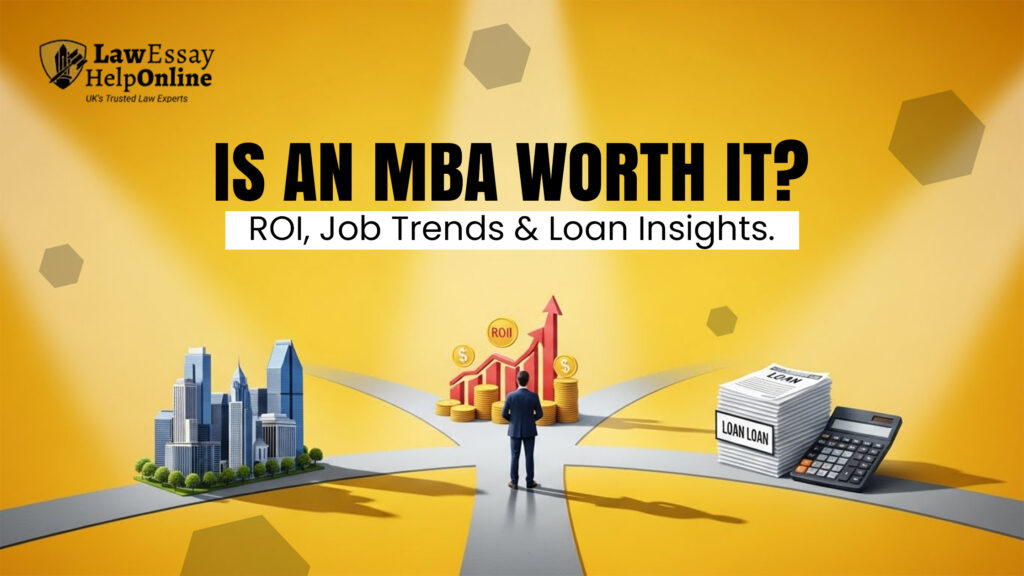
MBA is not as easy to pick these days as it used to be. The increasing tuition fees, job market fluctuations, and skills have caused students to doubt the traditional degrees. The question many experts pose is whether it is worth doing an MBA when online programs and specializations can be obtained with ease.
Employers in 2026-27 are more attentive to applied skills, leadership capacity, and flexibility. This transformation has altered the way that the MBA programs provide value. The degree is not as much management theory as before. It has come to bridge the gap between data, strategy, and real-world decision-making.
The other question that can be asked is it is worth it to get an MBA when student loans are taking years to pay off. The solution is based on specialization, timing, and career goals. An MBA that has been wisely selected can continue to give good returns. A poorly planned one may not.
This blog describes ROI, job trends, the value of specialization, and loan facts. It helps you decide clearly.
Which MBA is Most in Demand in the Future?
MBA programs that are future-ready are those that are geared towards industry requirements. Hiring plans are overwhelmed by digital transformation, analytics, sustainability and financial strategy. Employers are attracted to those graduates who are able to use data and business acumen to solve problems.
Specialisations such as business analytics, finance, and product management are in high demand. The question posed by students has been, Is it worth doing MBA in business analytics despite the advent of automation? It is yes, to those who feel at ease with data interpretation and decision support positions.
Organizations attach importance to professionals who are capable of turning data into strategy. This will be required up until 2026. Graduates of the MBA who have exposure to analytics receive jobs in consultancy, financial technologies, and technology companies.
Diversity of expertise is no longer valued in industries as much as cross-functional thinking.
Is it Worth it to get an MBA anymore?
The value of an MBA depends on how you use it. Employers no longer hire based on degrees alone. They look for communication skills, leadership ability, and a problem-solving mindset.
An MBA still works as a career accelerator when paired with experience. It helps professionals switch industries or move into leadership roles. For working professionals seeking structured growth, the degree offers credibility.
Many students also combine study support tools like law essay help during academic research phases. Such resources reduce workload pressure without affecting learning outcomes.
An MBA is no longer a guarantee. It is a multiplier. The return depends on clarity of purpose.
What is the Toughest MBA Specialization?
The difficulty level of an MBA specialization varies from student to student. It largely depends on academic background, skill set, and learning style. Some specializations demand strong numerical ability, while others require analytical depth and time management. Understanding these differences helps students choose a path that aligns with their strengths and career goals.
Specializations That Demand High Analytical Skills
The difficult MBA specializations are usually regarded as finance, operations, and business analytics. These areas entail intricate data processing, quantitative models, and strict time limits. Case studies, calculations, and real-time problem solving require the students to deal with, and in this case, a good base of analysis is needed.
Is an MBA After MTech a Tough Transition?
Most engineering graduates would pose the question, is it worth doing MBA after MTech when there are already technical positions that are paying competitive salaries? To those who would want to hold a leadership post, yes. MBA develops people, managerial and strategic skills, which are not likely to be taught by technical degrees.
Managing Academic Pressure Effectively
Allowing electives to run parallel with research modules, students can also ask and get Law assignment help to cope with the workload effectively. Through planning and academic guidance, stress can be minimized.
In any case, the MBA is not the most challenging academically. It is the one that is not in line with your natural abilities and career orientation.
Which MBA has a High Salary?
Salary outcomes depend on industry, geography, and specialization. Finance, consulting, and technology-focused MBAs consistently offer higher compensation.
The benefits of doing MBA in Finance include strong placement pipelines, global demand, and leadership roles in banking and investment firms. Finance graduates often secure positions with faster salary growth.
Students researching comparative academic paths sometimes explore Law dissertation topics alongside business studies. This crossover suits corporate law and compliance careers.
High-salaried MBAs demand long hours and continuous skill upgrades. They reward commitment.
What are the Advantages of an MBA?
The value of an MBA is more than just monetary performance. It equips the individuals to become leaders, enhancing strategic thinking, communication and professional confidence in individuals. The program is used to make students know the way business is conducted in terms of functions and industries. It is based on this foundation that enhanced decision-making and career development in competitive settings within a long-term perspective.
Leadership and Strategic Thinking Development
The benefits of doing an MBA are the development of leadership confidence and a good strategic mind. Students get to know how to assess intricate business scenarios and develop solutions. Case-based learning enhances analytical skills and equips graduates to be in management positions.
Early Career Momentum After Graduation
Many students choose the advantages of doing MBA right after graduation to gain early clarity in their careers. This approach helps them enter management tracks sooner. While early enrolment builds strong fundamentals, work experience later enhances practical understanding.
Interdisciplinary Knowledge Through Capstone Projects
During capstone projects, students often explore contract law dissertation topics to gain interdisciplinary insights. This exposure strengthens business-law understanding and supports better risk assessment in real-world business decisions.
Decision-Making and Professional Mindset
MBA determines the way of thinking and behaviour of people in the workplace. It teaches students to take challenges with confidence, make the right choices, and be leaders in changing business environments.
Why is an MBA better than a Master’s?
An MBA differs from traditional master’s degrees in approach. It emphasizes application, leadership, and case-based learning. Students work on real business problems, not just theory.
MBA programs also offer stronger industry exposure. Internships, live projects, and alumni networks enhance employability. Many learners seek Law dissertation help when research overlaps with governance or compliance modules.
Traditional master’s degrees focus deeply on one subject. MBA builds breadth across functions. This versatility supports long-term career growth.
The MBA teaches how businesses operate as systems.
ROI of an MBA in 2026–27
ROI is determined by the cost of tuition, salary after MBA, and the rate of career advancement. Even the best programs will continue to have a positive ROI in three to five years. Medium-tier programs must be selected.
Cheap MBAs with good placement history can perform better than expensive degrees. Opportunity cost is also minimized in online and hybrid formats. Students in balance with coursework can get assistance with Law coursework help at the peak academic stages.
ROI is enhanced when students are able to select specializations and industries of high demand. Location also matters. The international markets are more remunerative but competitive.
Job Trends Shaping MBA Outcomes
Employers seek adaptable leaders. Skills like critical thinking, data literacy, and ethical judgment matter more than titles.
Remote work has expanded hiring pools. MBAs now compete globally. This increases pressure but also opportunity.
Industries like healthcare, fintech, and renewable energy actively hire MBA graduates. Programs aligned with these sectors show better outcomes.
Career success now depends on continuous learning after graduation.
Loan Insights and Financial Planning
An MBA loan is an issue for several students. The increase in interest rates dictates cautious borrowing. Financial pressure is minimized with scholarships, employer sponsorships and part-time programs.
Repayment schemes based on income allow one to deal with the pressure of the early career. Students are not supposed to over-borrow on the basis of salary assumptions.
Academic performance is not as crucial as financial literacy in an MBA.
Final Thoughts
The MBA of 2026-27 will be useful, but it must be carefully selected in terms of objectives and strategy. Even a degree is not a guarantee of success anymore. Employers have shifted their attention to practical skills, the ability to lead and a thinking mindset in regard to solving problems. A market-oriented MBA can facilitate long-term career development.
The students should consider the return on investment. Reality should be evaluated in terms of tuition fees, loan debt, and anticipated salary. Making the correct decisions of specialization, study format, and institution is a major contributor to the results. Real-world exposure and applied learning programs are superior to those that are not.
The timing at an individual level is also important. Others have the advantage of work experience before joining, and others have a momentum from studying at an early age. Finally, an MBA is a long-term investment. It can be the key to leadership opportunities and a long-term professional career when taken seriously.
Pay Less Get More
- The Best Writer
- Formatting
- Unlimited Revisions
- Outline
- Title Page
- Plagiarism Report
- Topic Selection
Save £160.93 on Each Order


 Whatsapp
 Contact
 Call
Call Live Chat