


Can Law Students Use AI for Essay Writing? Ethical View
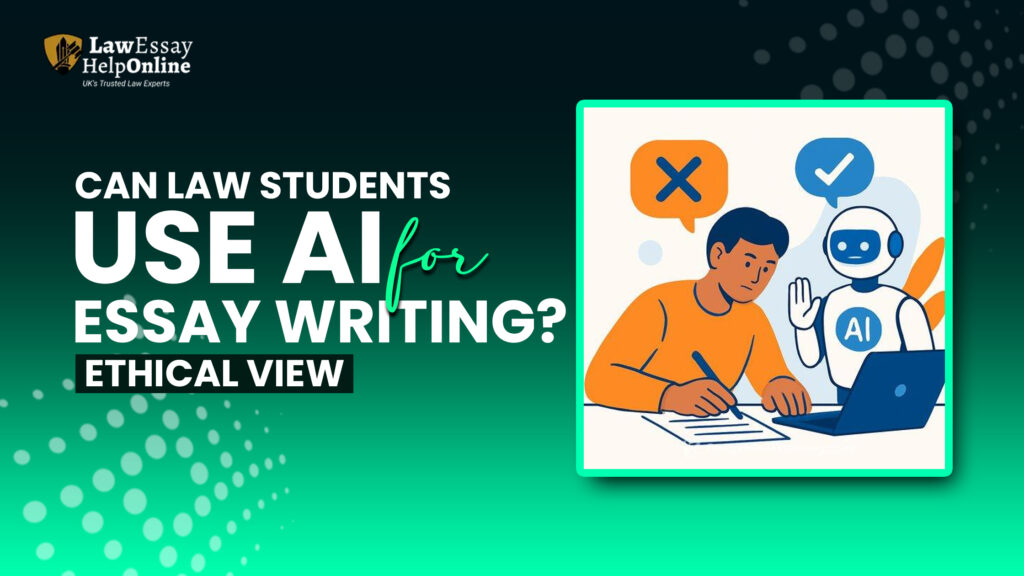
AI has revolutionized education, particularly at the college level. AI has reshaped higher education. Students can now brainstorm ideas, enhance grammar, and arrange research with the help of AI. That’s not just the case for law students. But in law school, accuracy, critical thinking, and ethical decision-making are required. These expectations give rise to several questions: Does AI belong in academic writing? These questions lead to inquiries about the possibility of incorporating AI into academic writing.
As universities introduce new policies on generative AI, the debate continues to heat up as to whether or not law students can use AI. There are some institutions that allow it for research and editing, while others prohibit its usage unless students make it clear that they have used it. Students will know the rules and be able to avoid academic dishonesty.
Understanding AI for Law Essay Writing
AI for Law Essay Writing can aid students in various writing phases. AI models can provide legal insight, outline essays, summarise lengthy legal opinions, and enhance sentence structure. When employed judiciously, these features can save a lot of time.
But AI can’t do everything. Writing law essays is a skill that enables students to read, understand, analyse, and interpret laws and existing judicial decisions and to build a convincing argument supported by authoritative evidence. AI’s generic answers can be inaccurate when it comes to the jurisdiction.
Students should therefore see AI as a supplement to their own legal knowledge to help them.
The Use of AI in Law can be Quite Profound
Transparency, honesty, and adherence to university regulations are essential to the ethical use of AI in legal education. There are ethical issues when students present work created by an AI without proper attribution.
Facts are not the only thing that universities judge. They also assess analytical, legal, and academic writing abilities. Overreliance on AI will hinder students from acquiring these skills.
Numerous law schools have started to post instructions on acceptable AI use. Pupils ought to read these policies out prior to making use of AI while composing coursework or a dissertation.
Some Challenges with AI in Law School Essays
There are academic hazards to using AI in law school essays. There are times when AI systems provide wrong legal information or reference to non-existent cases. This can be referred to as “AI hallucination” and has the potential to significantly impact legal tasks.
A second issue is the out-of-date information. The laws are constantly evolving, and they are the product of new laws and judicial rulings. Responses from artificial intelligence may not accurately capture the most recent changes in laws since the information on them has been generated by multiple entities that may not be up to date.
As such, primary legal materials and trustworthy academic databases should always be the basis for conducting legal research.
Identifying the Correct AI Tools for Legal Students
There are a number of AI tools for law students that can enhance productivity without compromising on independent thinking. Some applications summarise journal articles, organise research notes, and can help improve grammar or create study questions for revision.
Students can also efficiently manage the organisation of citations with reference management software. Legal Research Databases are still relevant due to their ability to deliver verified law, case law, and scholarly commentary.
Students should check any material generated by AI against credible legal sources before using that information for academic purposes.
Why Academic Integrity and AI Writing Matter
Academic honesty and cheating with AI have taken a turn for the worse in schools. Academic integrity and AI writing are huge issues in schools. Academic honesty is expected of each student to plan for originality of work, to give proper credit to the work of others, and to avoid plagiarism.
If you submit plagiarized AI-generated content without proper citations, it could be a violation of the institution’s rules. Students are accountable for each and every sentence that is provided in their name, even if it is accurate information generated by AI.
Academic integrity is important, and so is professional integrity. Ethical values are particularly relevant in the law school environment, where ethics are a component of practice.
Using AI Responsibly
The first step to responsible use of AI is to know its capabilities and limitations. Students can utilize AI to brainstorm ideas, clarify legal terminology, and structure sentences. Nevertheless, they should analyze the law on their own and create their own arguments.
It is also important to work on your legal research, critical thinking, and writing skills when using law essay help, instead of just turning to automated tools.
Ethical Application of AI in Essay Writing
The responsible AI use in essay writing is about how technology can help, not supplant, the learning process. However, students should not use AI to write their own content. Students should not create their own text using AI, but instead use AI for brainstorming, outlining, proofreading, or simplifying complex legal concepts. The analysis, legal argument, and conclusions must never be written by someone else, but must contain the students’ own analysis.
Structure and format all claims in a law essay by checking them with legislation, case law, and legal literature. Prior to using AI, students should also read through university policies to prevent accidental academic dishonesty.
The Advantages of using Legal Writing AI tools Include
When utilized judiciously, Legal writing with AI assistance can enhance the efficiency of legal writing. AI can suggest more coherent sentence structures, identify grammatical errors, and classify and structure lengthy information into logical sections. AI can suggest a more coherent sentence structure, identify grammatical mistakes, and organize long information into logical paragraphs. The features allow students to dedicate more time to analyzing the legal principles.
AI is no replacement for legal knowledge, however. The skills of interpreting statutes, analysing judicial decisions, and presenting persuasive arguments in the context of facts are all essential components of legal writing. These skills are not innate; they must be learned.
In the case of students undertaking a specific research project, other dissertation topics might be considered, such as international law dissertation topics or Family law dissertation topics, for example, to review the debate and issues in these areas.
Understanding AI essay writing ethics
The discussion about AI essay writing ethics continues, with universities making revisions to their academic policies. Rising to the level of honesty, transparency, and responsible decision-making is key to the ethical use!
Students are not allowed to present work that has been created by AI as their own. If disclosure is mandated as outlined in institutional guidelines, it is expected that this should be stated in such a way that it is evident how the AI has been used in the work. Academic integrity is maintained, and responsible innovation is promoted, through ethical practice.
However, as technology becomes part of the writing process, universities are increasingly requiring students to demonstrate independent thinking, even in parts of the writing process.
Following the Law student AI writing guidelines
Law student AI writing guidelines may differ across schools, and before using AI tools, it is important to always follow the set guidelines of the school. Some universities allow using AI to improve language or to come up with ideas for an entire assignment, but will not allow AI to generate the entire assignment.
It’s academic best practice to take notes of prompts, to check all references, and edit/clean up AI-generated suggestions. The process reduces the risk of misinformation while maintaining originality.
If a student requires additional Law dissertation writing services, he or she can contact a service provider for suggestions on how to research, structure, and cite, not only AI-generated.
An Equal Balance of Technology and Legal Skills
Although AI will be a part of legal education, its function will be to complement rather than replace the traditional pedagogies. Research, critical evaluation, and good arguments are all important attributes of good legal writing. These skills continue to be important for studying and working as a lawyer.
When students understand AI, they will be better equipped to solve problems and have a deeper understanding of legal principles when used in conjunction with independent analysis. This balanced approach will prepare them for the exams at the University and for their future employment.
Conclusion
Responsible and ethical use of artificial intelligence can provide great assistance to law students. It can help improve organisation, research, and writing skills, etc., but is not a replacement for independent legal analysis or critical thinking. Universities are continually updating their AI policy, and it’s important for students to know what their universities expect of them before using it. Students can utilize technology responsibly and effectively while maintaining academic honesty and ethics with the help of AI, while performing thoughtful legal analysis and reasoning.
❓ Frequently Asked Question's
Is it possible for law students to write an essay using AI?
Indeed, there are several universities that permit the use of AI for brainstorming, editing, or research. However, policies must always be followed by students, and a student analysis of the policy must be made.
Is it ethical to use AI to create law essays?
If used properly and within the guidelines of the University, it may be ethical. The consequences of submitting work generated by AI as an original without permission are problematic. Submitting original content with the help of AI without permission is problematic.
What could the dangers of using AI be for legal academic writing?
Potential problems include incorrect legal information, fake citations, out-of-date legal information, plagiarism, and/or university rules violations.
What is there to be done with AI for law students?
Students will use AI as a planning aid, for proofreading, or to help explain; students find legal authorities and prepare their own argument.
Are law essays acceptable with AI content at universities?
Please refer to the policies of each University. Some allow limited assistance from AI; others disclose it or ban content completely generated by AI. Students are advised to always refer to their institution’s official policy.
Pay Less Get More
- The Best Writer
- Formatting
- Unlimited Revisions
- Outline
- Title Page
- Plagiarism Report
- Topic Selection
Save £160.93 on Each Order


